
Most homes in this series look grand. This home, however, does not fit that mold. From the street, it looked plain. In addition, in a quiet part of the Chicago area, it sat unnoticed. Yet it holds one of the darkest crime tales in US history.
John Wayne Gacy killed young men and boys in the 1970s. Police also later found most of the dead in and near his home. As a result, a court found him guilty of 33 murders. In 1994, the state put him to death.
The old house no longer stands. Furthermore, in 1979, workers tore it down. Today, a new house sits on the same lot. This piece tells that full tale in plain terms. In fact, it does not praise the man. Nor does it treat the home as a show home. Instead, it keeps the focus on facts, on the dead, and on what changed after.
John Wayne Gacy House Location in Norwood Park, Chicago Area
Similarly, the home sat in Norwood Park. That area sits on the edge of Chicago. In fact, it feels like a calm suburb. There, homes look neat and plain. In addition, at night, streets stay quiet. Gacy lived on the fringe of the city, not in its heart. Close by, neighbours lived nearby. Shops and schools, meanwhile, sat near by. Moreover, the area gave no hint of what went on inside one home.
This piece gives the area name only. It does not give a street pin. Furthermore, nor does it give a route to the lot. Today, the new home on the lot holds private folk. They did not take part in the crimes. Consequently, they deserve peace.
When Did John Wayne Gacy Buy the Norwood Park House?
In fact, Gacy bought the home in 1971. His mother helped pay for it. For the buy, she used her own savings. At first, he moved in with her. Similarly, later, he lived there on his own terms.
The year matters. After this buy, his crimes in Chicago took place. In addition, the home gave him a base in the area. It also gave him a shield. To neighbours, he looked like a home owner, not a threat.
He did not buy a grand estate. Moreover, instead, he bought a plain home in a plain area. That plain look forms a key part of the tale.
John Wayne Gacy House History and Ownership Background
Gacy came into life in Chicago in 1942. Furthermore, he grew up in the city. For a time, he later moved to Iowa. There, he ran food outlets for his wife’s kin. In fact, in 1968, a court in Iowa sent him to jail. He served less than two years there.
In 1970, he came back to Chicago. Soon after, his first wife left him. He then lived with his mother for a time. Similarly, in 1971, they bought the Norwood Park home.
Soon after, he set up his own firm. He called it PDM Contractors. In addition, the firm did build work in the area. It grew fast. In addition, it hired many young men for jobs.
Later, his mother moved out. Gacy also stayed on in the home. Through the 1970s, he kept the home. In late 1978, police seized the home. After that, the state took charge of the lot.
The Neighbour Who Seemed Ordinary: Gacy’s Public Life in Norwood Park
Furthermore, neighbours saw a busy local man. He ran a firm. In local groups, he also took part. At fairs and fetes, he helped out. In fact, as a clown at kids’ events, he dressed up. Kids and grown-ups knew his clown face.
He gave work to young men in the area. Similarly, for build jobs, he paid them. To job sites, he drove them. To neighbours, he seemed keen to help folk find work.
In addition, this public face hid a dark truth. Folk who knew him later said they felt shock. They had seen no sign of the crimes. Moreover, that shock still shapes how folk talk of the case.
No one should read this as praise. His good deeds do not make up for his crimes. Furthermore, they show how well he hid them. Similarly, they show why folk missed the signs.
The House in the 1970s: What It Looked Like From the Street
From the street, the home looked like its peers. It had one main floor. In fact, above it sat a low roof. At the front, it had a plain face. Around it lay a yard and a drive.
Similarly, cars came and went at all hours. Work vans parked out front. Young men came for jobs. In addition, folk saw no cause for alarm. In the street, the home did not stand out.
Inside, the home had rooms for day to day life. Moreover, for guests, it had a front room. At the back, it had rooms for rest. For tools and vans, it had a garage. Furthermore, that plain look helped Gacy hide his acts for years.
What Makes This House Different From Other Famous Houses?
Most famous homes draw folk for their size or style. This home, in contrast, draws folk for its past. Its past brings grief, not awe. In fact, its tale asks hard things of those who read it.
The home shows how a plain place can hide dark acts. It shows how trust can turn to harm. Likewise, it shows how a man can use a home as a trap.
Similarly, that is why this piece does not use show-home words. It does not call rooms grand or chic. Nor does it urge folk to seek out the lot. It treats the home as a crime site first. In addition, it treats the dead with care.
John Wayne Gacy House Architecture, Size and Land
The old home had a ranch style. Ranch homes sit low and long. They also spread out, not up. They suit flat lots in suburbs.
The home had one main level. Furthermore, in parts, it had a brick front. Over it lay a roof with a low slope. Around it, a yard gave room to park and work.
In fact, public notes do not give one clear size that all agree on. They do not give one clear room count that all agree on. This piece does not guess at those counts. Similarly, instead, it sticks to the style and the lot tale.
The lot itself matters more than the floor plan. The lot held the home. In addition, it held a yard. In addition, it held space where police later dug. The lot tale did not end when the home came down.
Inside the Original House, As Documented in the Investigation
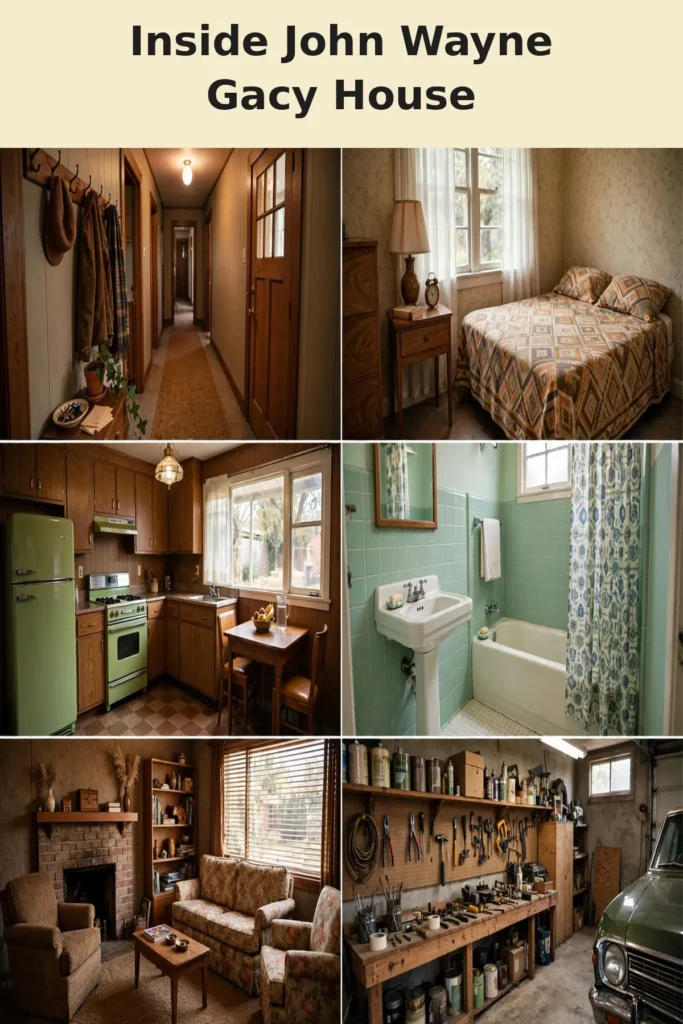
Police notes give a plain view of the home. Moreover, the home had no grand halls. It had no rare art on show. For work, rest, and guests, it had rooms. Furthermore, the notes below stay factual. They give no graphic detail.
The Layout, As Described in Public Records
The front of the home held rooms for guests. In fact, folk who came for work waited there. The back of the home held rooms for rest. A hall linked the front and back rooms.
Similarly, the home had a garage at one side. Gacy kept tools and vans there. He kept work gear there too. In addition, the garage formed part of his firm life.
The home had a low space under its floor. Builders call this a crawl space. Moreover, it held pipes and wires. It gave access to the base of the home. It did not serve as a living room.
The Crawl Space and the Property, In Factual Terms Only
Furthermore, police dug under the home in late 1978 and in 1979. They found 26 dead in the low space under the floor. Elsewhere on the lot, they found 3 more dead. In fact, that makes 29 dead on the lot in total.
Police also found 4 more dead in rivers near Chicago. Those 4 did not lie on the lot. They still form part of the 33 total. Similarly, this split clears up a point that oft confuses folk.
Some folk say 29. Others say 33. In addition, both counts refer to parts of one total. Police found 29 on the lot. In rivers, police linked 4 more to the same man. Moreover, the court case dealt with 33 in all.
This piece does not go into how the man killed his victims. It does not give step by step detail. Furthermore, the facts above give the scale. They give it with care for the dead.
What Was Found, and What Was Not Part of the House
Police found more than bones in the home. In fact, they found bits of cloth. They found small items that tied folk to the home. With those items, they named some of the dead.
Similarly, police did not find a grand vault in the home. They did not find a maze of rooms. Nor did they find a set built for show. In addition, the home stayed plain, even as police dug through it.
The dig hurt the home frame. Workers dug deep and wide. Moreover, the frame grew weak. That harm later forced the state to tear the home down. The home could not stay safe to use.
Security and Privacy
Furthermore, this part does not deal with rich home alarms. It deals with police watch in late 1978. Police watched the home day and night. In fact, they watched who came and went. They checked Gacy’s past.
Police then sought a court order to search the home. A judge gave them that order. Similarly, in December 1978, police searched the home. They found the first signs of dead in the low space. After that, they dug on a large scale.
Gacy spoke to police soon after. He owned up to the killings. In addition, from that point, police held him in jail. While police dug, the home stayed sealed.
The Investigation That Ended at the House: December 1978
A teen vanished on December 11, 1978. His name was Robert Piest. He also was 15 years old. At a drug store in Des Plaines, he worked. To talk to a man about a job, he left work. Furthermore, that man was Gacy.
Witnesses told police about Gacy. Police checked his past in Iowa. In fact, they saw his jail term there. At once, they put him under watch.
Police searched his home twice in December 1978. The second search found proof that tied Piest to the home. Similarly, police found a slip for film that Piest had picked up at work. That slip sat in the home.
Gacy owned up to police on December 22, 1978. The next day, police dug under the home. In addition, at once, they found dead. The dig went on for months.
The Trial and Execution of John Wayne Gacy
The case went to court in Chicago in early 1980. Moreover, the trial began on February 6, 1980. Gacy pled not guilty by reason of insanity. A jury heard the case. Furthermore, the jury rejected that plea.
The jury found Gacy guilty of 33 murders on March 12, 1980. A judge gave him a death term the next day. The court case then moved to years of appeals.
Gacy spent more than 14 years on death row in Illinois. In fact, the state put him to death on May 10, 1994. Workers carried out the sentence at Stateville Correctional Center. They used lethal injection.
Similarly, his death closed the court case. It did not close the grief for kin. Nor did it name every victim. In addition, that work still goes on today.
Demolition in 1979 and the New House Built in 1986
Workers tore the old home down in April 1979. Police had dug through its base for months. Moreover, the frame could not stand safe. The state chose to tear it down, not fix it.
The lot stayed bare for years. Furthermore, no one built on it at once. Folk in the area watched the bare lot with care. The lot held a dark past. In fact, it took time for the area to move on.
A new home rose on the lot in the mid-1980s. Reports place the build in 1986. Similarly, the new home looks plain, like its peers. It does not look like the old home. Nor does it hold the old home’s rooms.
In addition, the lot got a new street number at that time. The change aimed to cut the link to the old case. It aimed to let new folk live there in peace. The new home has had new owners since then.
What Is the Norwood Park Property Worth Today?
Moreover, the price tale here deals with the new home, not the old home. The old home no longer stands. No one can buy it. Furthermore, nor can anyone price it as a home.
Reports say the new home sold in 2021. One report puts the sale at about $395,000. In fact, another report puts it at about $391,000. The two counts differ by a small sum.
This piece does not pick one count as true. Similarly, it gives both as reports. It notes the sale year as 2021. Prices shift with time and with the market. In addition, a 2021 sale does not set a price for today.
The lot value also carries a dark past. Some buyers may pay less for such a lot. Others may shun it outright. Moreover, the 2021 sale took time to close. That fact shows the past still weighs on the lot.
Other Places John Wayne Gacy Lived
Gacy did not live his whole life in Norwood Park. Furthermore, he grew up in Chicago. He lived in the city as a boy and a young man. His kin lived in Chicago too.
In fact, he later moved to Waterloo in Iowa. There, he ran food outlets. In local groups, he also took part. There, he first faced a court case. In 1968, a court sent him to jail there.
Similarly, he came back to Chicago after jail. He lived with his mother for a time. Then he bought the Norwood Park home in 1971. That home forms the main tale of this piece.
In addition, he lived nowhere else for long after 1971. His last home was a jail cell. He spent his last years on death row in Illinois. He also died there in 1994.
Where the Story Stands Now: Identifying the Remaining Victims
Five victims still lack a name, as reports note. Police knew their bones but not their names for years. Furthermore, kin waited for news for years. Some kin still wait today.
Police in Cook County dug up the unknown dead in 2011. In fact, they took DNA from the bones. They asked kin of missing young men to give DNA too. They hoped to match bones to kin.
That work has named some of the dead since 2011. Similarly, in 2011, it named a man from Chicago. It named a teen from Minnesota in 2017. In 2021, it named a man from North Carolina.
In addition, work still goes on today. Labs test old bones with new tools. Police teams share data with DNA groups. Moreover, each new name gives kin a grave to tend. Similarly, each new name gives a dead boy back his tale.
This work matters more than house prices. It matters more than lot tales. It puts names first. Likewise, it puts kin first. Furthermore, above all, it keeps the focus where it should stay.
Frequently Asked Questions About John Wayne Gacy House
Where was John Wayne Gacy’s house?
It sat in Norwood Park, on the edge of Chicago. This piece gives the area name only. In fact, it does not give a street pin. The new home on the lot holds private folk now.
Does the original house still stand?
No, it does not stand. Similarly, workers tore it down in April 1979. Police digs had hurt its frame. The state chose to tear it down for safety.
What is on the lot now?
In addition, a new home sits on the lot. Builders put it up in the mid-1980s. It looks plain, like other homes near by. Moreover, it does not hold the old rooms. It does not hold the old past in its walls, but the lot tale stays.
Can you visit the house?
No, you should not seek it out. Furthermore, the lot holds a private home. Folk live there now. They did not take part in the crimes. Stay away and give them peace.
How many victims were found on the property?
Police found 29 dead on the lot. They found 26 under the home floor. In fact, elsewhere on the lot, they found 3 more. Police linked 4 more dead in rivers to the same case. The court case dealt with 33 in all.
Conclusion
Similarly, the Norwood Park home tells a grim tale. It looked plain. It hid dark acts. In addition, in the end, it fell to police digs and to time.
The old home no longer stands. A new home sits on its lot. Moreover, that new home belongs to private folk. They deserve quiet, not crowds.
The true tale here is not a house tale. Furthermore, it is a tale of 33 dead young men and boys. Five still lack a name. Police and labs still work to name them. In fact, kin still wait for news.
Readers should hold that fact first. A house can fall. A lot can gain a new home. Similarly, a name, once found, gives a dead boy back his place in the world. That work goes on. That work matters most.