
Some houses just hold old walls, and this house holds books. Samuel Clemens also lived here with his wife and girls. People know him by his pen name, Mark Twain, and, moreover, he wrote his best books in these rooms. In fact, he called this home the loveliest home he ever knew. Today you can, in fact, walk through it as a museum. There, you can see where he wrote, read, and played with his girls. At the same time, you can see how a rich writer lived in the late 1800s. This guide, therefore, tells the full story in plain words. Finally, it covers the place, the build, the rooms, the books, and the visit.
Mark Twain House Location in Hartford, Connecticut
The house stands in Hartford, Connecticut, and it also sits in the Nook Farm area. Nook Farm, in fact, was a quiet, leafy part of town. Rich and well known folk lived near it, and the house sits at 351 Farmington Avenue. That address is public. As a result, guests can find it with ease, since it serves as a museum now. Hartford, meanwhile, sits in the north of Connecticut, and it was a busy trade town in Twain’s day. There, he also found a base for work and for talks. From here, he could reach New York with ease, and he could also reach Boston with ease. That mix of calm home life and fast travel suited him well. Meanwhile, the site still draws book fans from far and wide.
When Was the Mark Twain House Built, and Who Designed It?
Workers, finally, finished the house in 1874. Edward Tuckerman Potter, in fact, drew the main plan. Alfred H. Thorp helped him with the work. Clemens and his wife, Olivia, had a clear wish, and, moreover, they wanted a bold home, not a plain box. Potter gave them steep roofs and odd shapes, and he also gave them tall turrets and wide porches. The plan took time, and consequently the cost grew as work went on. Clemens watched the build with keen eyes, since he liked odd and bright things. He liked a house with a strong face, and the end result gave him just that. Even today, it still turns heads on Farmington Avenue.
Mark Twain House History and Ownership Background
Clemens and his kin moved in during 1874, and, in addition, they lived there for 17 years, through 1891. Those years rank as his best years as a writer, and he wrote, spoke, and raised his girls here. Olivia, meanwhile, ran the home with care. Their girls grew up in its rooms, and, at the same time, the house saw good days and hard days. Money strain grew in the later years, and consequently the kin left Hartford in 1891. After that, they did not live in the house again. Clemens kept the house for years after they left, and he sold it in 1903. New folk used it in new ways, and at first it served as a school. Then it served as a branch of a library too. Folk later saved it from the wrecking ball, and workers restored it with care. In 1974, it opened as a museum, and it now holds the rank of a National Historic Landmark.
Samuel Clemens in Hartford: The Years That Made Mark Twain
Clemens came to Hartford as a known writer. He had, in fact, already made his name with tales of the West. Hartford gave him a new kind of life, and in addition it gave him rich friends and sharp minds. Moreover, it gave him a home full of books and talk. Nook Farm held writers, preachers, and reform folk, and they also met, dined, and shared ideas. That world shaped his voice in key ways, and, therefore, he wrote with more bite and more warmth here. He wrote about boys, rivers, and kings, and he also wrote about greed and pride in his own age. Folk later coined a term for that age, and they called it the Gilded Age. Twain, in fact, helped coin that term in a book. His Hartford years gave him the reach to do it. The house was not just a roof for him, and in fact it was a base for his best work.
Mark Twain House Tour: What You See on a Guided Visit
You can see the house on a guided tour only. A guide leads you from room to room, and the tour, in fact, lasts about one hour. You should, therefore, allow about two hours for the full visit. The full visit takes in the museum centre too, and guides, meanwhile, tell tales as they walk with you. They point out small things you might miss, and they also show you the woodwork and the stencils. Next, they show you the beds and the desks. You cannot take photos in the house, because that rule helps guard the old rooms. You can take photos out on the grounds, however, and the tour moves at a calm pace. It suits book fans and first time guests alike. It also suits kids who like tales of Tom Sawyer. Buy tickets in advance if you can, since tours can sell out on busy days.
What Makes Mark Twain’s House Unique?
Most old homes look neat and calm, and, in contrast, this house looks bold and odd on purpose. It mixes brick, wood, and bright trim, and, in addition, it has turrets that rise like small towers. It also has porches that wrap and curve. Folk once likened it to a river steamboat. Similarly, folk also likened it to a medieval fort. Some folk even likened it to a cuckoo clock. Those odd likenesses fit the house well, and, at the same time, it does not sit still in one style. It pulls from many styles at once, and consequently that mix makes it easy to spot. It also makes it hard to forget, and the rooms inside match that bold face. They mix rich colour with fine craft, and they mix fun with work. Twain wrote his best tales here for a reason, and, in fact, it gave him a stage for his mind.
Mark Twain House Architecture, Size and Land
The house holds 25 rooms, and that count, in fact, gives a sense of its scale. It stands tall on its lot in Nook Farm, and it also uses patterned brick on its outer walls. The brickwork, meanwhile, shifts in tone and shape. Steep gables rise above the roofline. Turrets add height at the corners. Wide porches give shade in warm months. Folk describe the style in two ways. Some call it American High Gothic. Likewise, some call it Continental Picturesque. Both terms point to the same thing, and the house, in fact, borrows from old Europe. It also keeps a bold American face, and the grounds add green space round the house. Trees and paths frame the brickwork, and the site feels calm, though the road runs near. The house still looks much as it did in Twain’s day. Restorers worked hard to keep it that way.
Inside Mark Twain House: Interior and Features
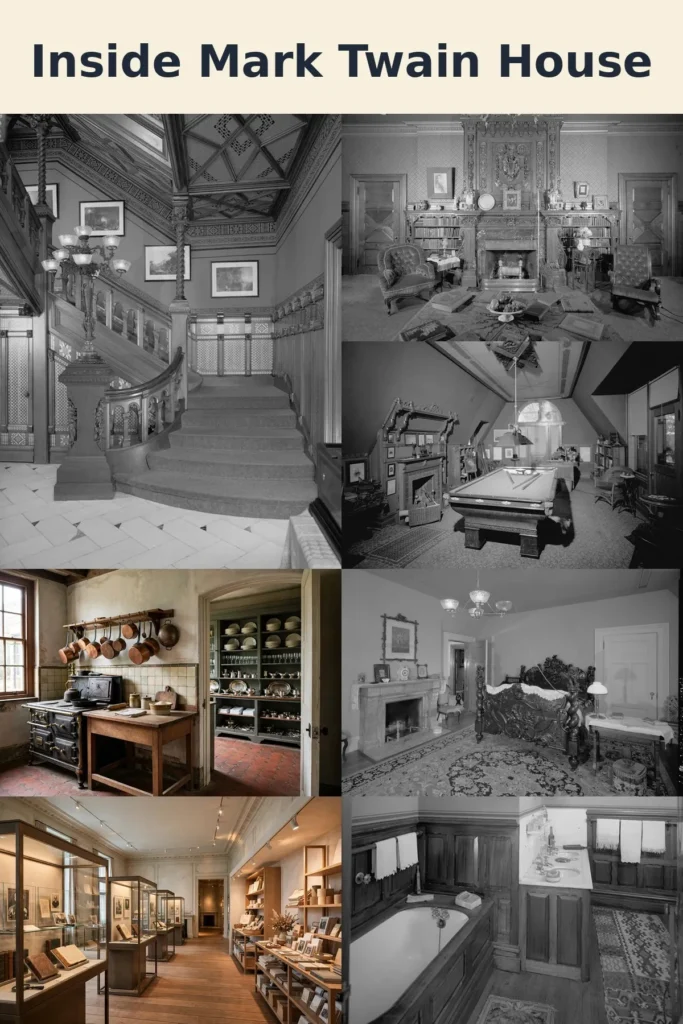
The rooms inside tell a clear tale, and they, in fact, show a home for work and for play. They also show rich taste and plain warmth at once. Tiffany’s firm shaped much of the look, and guides walk you through the key rooms in turn.
Grand Entrance and Central Hall
You step in through a bold front door, and the hall, in fact, opens wide in front of you. Stencils also cover the walls and ceilings. Carved wood frames the doors and stairs, and the hall, consequently, sets the tone for the whole house. It feels rich, yet it feels lived in too, and guests would pause here on their way in. They would take in the colour and the craft, and the hall links the main rooms with ease. Even now, it still greets guests much as it did then.
Library
The library, in fact, served as the heart of home life. Clemens also read new work aloud here. His girls sat near him as he read. A small chair for a child stands by his own chair, and that small touch says a lot. In fact, it shows a dad who loved his girls, and books line the walls in this room. Soft light fills the space through the day, and the room, consequently, feels warm and close. It feels like a place for tales, and it also feels like a place for rest.
Billiard Room, Where Twain Wrote
Twain, in fact, wrote in the billiard room upstairs. A billiard table stands in the room, and he also used the room as his work room. He liked to write at night, and he also liked smoke, talk, and games nearby. Friends would join him for a game, and they would talk while he worked on his tales. The room gave him space to think, and it also gave him space to pace and draft. Many of his best pages took shape here, and guides point out the desk and the table. They tell you how he used the room each day.
Bedrooms, Including the Carved Angel Bed
The bedrooms, meanwhile, sit on the upper floors, and they feel more plain than the grand rooms downstairs. They still hold fine craft and care. Twain’s bed stands out most of all, and workers, in fact, carved angels into its frame in Venice. The bed looks like art in its own right, and it shows the taste of the whole house. His girls had their own rooms nearby. A school room served the girls for lessons, and that room shows how the kin learned at home. The bedrooms feel calm and private, and they give a break from the grand rooms below.
Bathrooms and Servants’ Spaces
The house shows two kinds of life. One kind belongs to the Clemens kin, and the other kind belongs to the staff. Staff rooms and work rooms tell that tale, and guides show you how staff lived and worked. They show you the stairs staff used each day, and they show you the small rooms staff kept. Bathrooms from that age look plain to us now, and they still show fine craft in tile and wood. These rooms add truth to the tour, and consequently they stop the house from feeling like a stage set. They show real folk at work in a rich home.
Kitchen Wing and Butler’s Pantry
Workers restored the kitchen wing with care, and it shows how cooks made meals each day. It shows pots, stoves, and work tops from that age, and the butler’s pantry sits close by. Staff used it to serve meals with ease, and it held plates, glass, and silver in neat rows. The rooms feel plain next to the grand hall, and that plain feel is the point. It shows the work that kept the house smooth, and guests often like these rooms most. They feel real and close to daily life.
Museum Centre and Galleries
A new museum centre stands on the site, and workers built it in 2003. It holds rooms for shows and talks, and it holds a short film about Twain’s life. It holds changing shows about books and writers, and the centre also holds a shop and a café. You can rest there after the house tour. You can buy books and gifts there too, and the centre holds part of the vast collection. That collection holds about 50,000 items, and it holds books, photos, and kin items. It holds first editions and fine art, and in addition it helps guests grasp Twain’s long life.
The Books Written in This House
Twain wrote his best known books here, and he wrote The Adventures of Tom Sawyer here in 1876. He wrote A Tramp Abroad here in 1879, and he also wrote The Prince and the Pauper here in 1880. In 1884, he wrote Adventures of Huckleberry Finn here. Then he wrote A Connecticut Yankee in King Arthur’s Court here in 1889. Those five books alone would make a great career. Tom Sawyer gave us a boy full of tricks. Huckleberry Finn gave us a boy on a river. The Prince and the Pauper gave us a swap of lives. A Connecticut Yankee gave us a man out of time. A Tramp Abroad gave us sharp travel tales. Twain wrote them in the billiard room upstairs, and he read drafts aloud to his kin in the library. The house thus holds more than old rooms, and, in fact, it holds the birth of tales that still live today.
Leaving Hartford, Selling the House, and the Road to a Museum
The kin left Hartford in 1891, and they moved to Europe for a time. Money strain played a part in that move. Life abroad cost less than life in Hartford, and they never lived in the house again. Death struck the kin in hard ways. Their girl Susy died in 1896. Clemens felt that loss with deep pain, and he did not wish to live in the house again. He sold the house in 1903. New owners used it in new ways, and at first it served as a school for a time. Then it served as a library branch for a time, and it faced the threat of demolition in 1929. Folk who loved Twain stepped in to save it. A kin friend of a near neighbour led that fight, and workers restored the house in stages. They drew on kin help and old photos, and they opened the main rooms to guests in 1974. The museum centre followed in 2003, and the house now stands as a landmark for all.
What Did the Mark Twain House Cost, and What Is It Worth as a Museum?
Reports put the total cost at about $123,000, and that sum covers land, build, and furnishings. It dates from the 1870s, and that sum was huge for its day. It shows how bold the plan was, and it also shows how costs grew as work went on. You cannot put a market price on the house today. It serves as a museum, not a home for sale, and it holds landmark rank and a vast collection. Its worth lies in its tale and its rooms, and it lies in the books Twain wrote here. It lies in the crowds it draws each year. Do not read web guesses as a sale price. No sale price exists for a house like this. Its value is public, not private, and that fact sets it apart from most star homes.
Other Mark Twain Homes
Hartford was not Twain’s only home, and he lived in many places through his life. He spent youth years in Missouri, and he spent work years in the West. He spent later years in Connecticut too. Stormfield in Redding, Connecticut, stands out most, and he built Stormfield late in life. He lived there in his last years, and it served as his last main home. It does not match Hartford in fame. Hartford holds the books that made him. Stormfield holds the close of his life, and this guide keeps Hartford at the centre. It notes Stormfield just to round out the tale. Twain’s other homes add depth, not a rival claim.
Visiting the Mark Twain House Today
You can visit the house most days of the year, and it opens at 9:30 in the morning. It closes at 5:30 in the evening, and the last tour leaves at 4:15 in the afternoon. It closes on some holidays each year, and it closes on Tuesdays in the cold months. Check hours before you go, as they can change, and tours run on a guide led basis only. You cannot roam the house on your own, because that rule guards the old rooms and items. Buy tickets in advance when you can, since tours sell out days ahead on busy weeks. Allow about two hours for house and centre. Parking costs nothing on the site. A café serves light food on the site. A shop sells books and gifts. Ghost tours run on some fall nights, and the house wears holiday dress from late November through January. Check dates and prices before you go. Prices can change from year to year.
Mark Twain Net Worth and the Money Troubles Behind Leaving Hartford
Twain earned good money from his books, and he earned good money from talks too. He drew large crowds on stage, and he sold books in large numbers. Yet he spent on a grand scale, and the Hartford house cost a lot to build. It cost a lot to run each year. Staff, food, and upkeep added up fast, and he also put money in risky deals. Those deals did not pay off as he hoped, and money strain grew through the late 1880s. The kin left for Europe in 1891 in part to cut costs. No clean net worth sum fits his life. His wealth rose and fell with each year. His debts and his gains moved in turns, and the house stands as proof of both sides. It shows his great success in Hartford, and it also shows the cost of that success.
Frequently Asked Questions About Mark Twain House
Where is the Mark Twain House?
The house stands at 351 Farmington Avenue in Hartford, Connecticut, and it sits in the Nook Farm area. It serves as a public museum today. You can reach it with ease by car.
Which books did Twain write there?
He wrote Tom Sawyer there in 1876, and he wrote Huckleberry Finn there in 1884. In 1880, he wrote The Prince and the Pauper there, and he wrote A Tramp Abroad there in 1879. Finally, he wrote A Connecticut Yankee in King Arthur’s Court there in 1889.
Can you visit without a guided tour?
No, you cannot. You can see the house on a guided tour only, and guides lead each group from room to room. Meanwhile, you can roam the museum centre on your own. You can also roam the grounds on your own.
How much are tickets?
Check prices before you go, as they can change. Recent prices run about $28 for adults, and they run about $26 for seniors. They run about $15 for kids aged 6 to 16. Kids aged 5 and under go in free. Museum galleries only cost about $8. Living history tours cost a bit more.
Is the house haunted?
Some guests tell ghost tales about the house. In the billiard room, some say they smell cigar smoke. For example, some link those tales to Susy and to Twain, and the museum does not claim ghosts live there. It runs ghost tours on some fall nights. Those tours play on the tales for fun. Treat the tales as lore, not as fact.
Conclusion
The Mark Twain House still earns its fame, and it is not just a pretty Victorian home. It is the place where Tom Sawyer took shape. Here, Huck Finn took to the river, and the house shows a writer at his peak. It shows a kin at home in Hartford, and it shows rich taste and real work side by side. It also shows the cost of a grand life, and that mix makes the visit worth your time. Plan ahead, buy tickets in advance, and check hours first. Walk the rooms with a guide. Pause in the library and the billiard room. Think of the tales that took shape there. You will leave with a clear sense of Twain. You will also leave with a clear sense of his home.