Hidden behind greenery in Portland, Oregon, Rimsky-Korsakoffee House occupies an old residential building that feels far removed from an ordinary coffee shop. Opened in 1980 by Goody Cable, this unusual late-night destination combines classical music, homemade desserts, candlelit tables, and playful decorations. Its reputation also rests on mysterious moving tables and a famously strange upstairs bathroom. Located in the Buckman neighborhood, the coffeehouse has maintained its unconventional character for decades. The building’s historic architecture, distinctive interior, and long-running ghost stories make it a recognizable part of Portland’s independent dining culture.
Rimsky-Korsakoffee House Portland
Located at 707 SE 12th Avenue, Portland, Oregon 97214, Rimsky-Korsakoffee House occupies a former private residence near the intersection of Southeast 12th Avenue and Southeast Alder Street. The address places the business in the Buckman neighborhood, an area on Portland’s east side. Its leafy exterior makes the building less obvious than a typical commercial café. The lack of a prominent street sign has long been part of its identity.
The coffeehouse serves coffee, tea, cakes, and ice cream desserts rather than a full savory menu. Evening opening hours distinguish it from conventional daytime cafés. Current published hours are Wednesday through Sunday, from 7 p.m. until midnight, with closures on Mondays and Tuesdays. Guests should check the official website before visiting, since business hours and menu prices can change.
Music remains central to the experience. Classical performances, including piano and string music, complement the candlelit rooms and composer-themed tables. The business takes its name from Russian composer Nikolai Rimsky-Korsakov, connecting its identity to the musical gatherings that inspired its creation. Its atmosphere encourages conversation rather than laptop work, and the current official information states that Wi-Fi is unavailable.
Unlike a conventional restaurant, the house does not accept reservations. Seating is first-come, first-served, and weekend evenings can bring a wait. The porch provides a recognizable place for arriving guests to gather while waiting for a table.
Rimsky-Korsakoffee House Tour
A visit to Rimsky-Korsakoffee House begins outside a traditional storefront experience. Rather than approaching a brightly marked business, guests look for an older house partly concealed by surrounding greenery. Its residential appearance is an important part of the appeal: the building feels like a private home that gradually became a public gathering place. The front porch and historic exterior provide the first clues to its unusual character.
Inside, the rooms combine the layout of an older house with the furnishings and decorations of a dessert café. Tables are named after composers, and the lighting is deliberately subdued. Candles, unusual objects, artwork, and music create an atmosphere that changes noticeably from the street outside. The result is intimate without resembling a conventional formal dining room.
The experience is as much about the building as the menu. Guests may notice unexpected movement from specially constructed tables, unusual wall decorations, and objects suspended from ceilings. The interior rewards attention because the details are scattered throughout the rooms rather than arranged around a single central attraction.
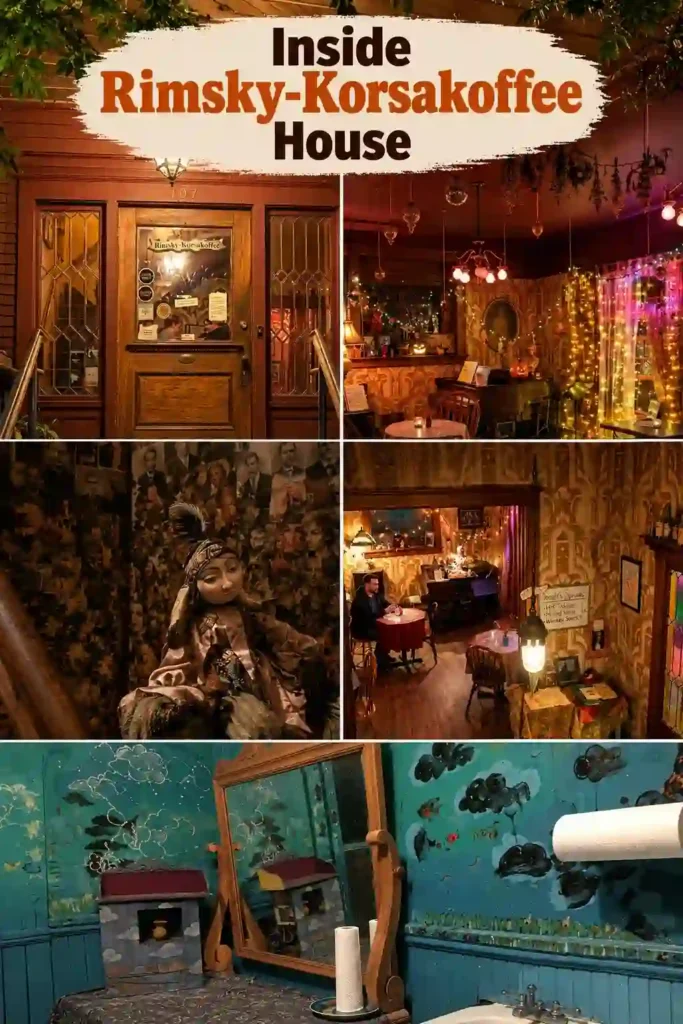
A tour also reveals how the business has preserved its informal character. The coffeehouse does not depend on digital entertainment or a modern café layout. Conversation, music, desserts, and the building’s peculiar furnishings shape the visit. Photographs in the official gallery show the porch, dining rooms, underwater mural, and puppet decorations.
Inside Rimsky-Korsakoffee House Interior and Other Features
Rimsky-Korsakoffee House features candlelit rooms, composer-themed tables, unusual artwork, and quirky decorations that reflect its musical roots. The interior combines the warmth of an old residential house with playful details, including moving tables and an underwater-themed bathroom. Classical music and homemade desserts add to the atmosphere, making this Portland coffeehouse memorable for its distinctive character and unconventional design.
Grand Entrance
The exterior of Rimsky-Korsakoffee House retains recognizable details from its residential past. Oregon’s historic-site record describes a two-and-a-half-story building with a full-width front porch, stone piers, turned columns, and a hipped porch roof. A half-glazed wooden entrance door with broad leaded sidelights adds period detail to the front elevation.
The state record dates the building to 1904, although some contemporary descriptions and business materials refer to it as a 1902 house. That discrepancy matters when discussing its age. The available official historic record supports 1904 as the construction date, so 1902 should not be treated as an uncontested architectural fact.
Greenery around the property partly conceals the building from passing traffic. Its porch, columns, and traditional residential form contrast with the business operating inside. Rather than replacing the house’s identity with a standard commercial façade, the coffeehouse uses its original appearance as part of the experience.
A Lively Space
The main rooms combine candlelight, classical music, desserts, and relaxed seating. Composer names identify the tables, creating a direct connection between the décor and the coffeehouse’s musical theme. Live performances have been a recurring feature, with piano and string musicians playing on various evenings.
The furnishings do not follow a coordinated restaurant design. Older furniture, decorative objects, unusual wallpaper, and artwork contribute to the informal atmosphere. Visitors may find notes and other small mementos beneath glass tabletops, reflecting the habit of leaving traces of past visits. Eater Portland described these tables as holding personal notes and fragments of the coffeehouse’s social history.
Music is not simply background entertainment here. The classical theme connects the business name, the table names, and its original purpose as a place for musical gatherings. Guests may encounter a live performance or hear music while ordering dessert. The combination helps distinguish the rooms from a typical coffee bar designed mainly for quick service.
A Whimsical Puppet-Themed Space
Unusual decorations appear throughout the interior, including hanging figures, theatrical objects, and artwork that gives the house a deliberately eccentric personality. Photographs in the official gallery show puppet-like decorations near the staircase and a hand-painted underwater mural along an interior hallway.
These details complement the coffeehouse’s reputation for surprise. Rather than limiting its theme to musical portraits or traditional café accessories, the interior mixes different visual styles. The result is playful, occasionally eerie, and difficult to mistake for a standardized restaurant.
The puppet-themed decorations also fit the building’s broader approach to entertainment. Guests encounter visual oddities while moving between rooms, so the experience extends beyond sitting at a table. Public photographs document several of these features, although they do not establish that every object remains in exactly the same position today.
Special & Unique Spaces
Composer-themed tables are among the coffeehouse’s best-known attractions. Several have mechanical features that cause them to move, rise, rotate, or shake. Eater Portland reported three moving tables on the ground floor, while older accounts describe individual mechanisms associated with particular composers.
The unusual furniture is often folded into the house’s ghost stories. Guests may describe a moving table as supernatural, but the reported movements are physical effects associated with the furniture rather than verified evidence of paranormal activity. Their theatrical quality gives the café a memorable feature that ordinary dessert shops rarely attempt.
Additional spaces preserve the feel of a house rather than a purpose-built restaurant. Couches and informal seating have appeared in descriptions of the interior, while the upstairs area contains its own collection of unusual decorations. Blank journals and notes left by guests have also formed part of the coffeehouse’s informal culture.
These details contribute to the impression of a place shaped by its regular visitors as well as its owner. The décor is not simply a backdrop for coffee. It is part of the reason the venue has remained recognizable across decades of changes in Portland’s café scene.
Bathroom
The upstairs bathroom is one of the best-known features of Rimsky-Korsakoffee House. Accounts describe an underwater theme with mannequin parts and theatrical objects, including a kayak. Eater Portland has reported that the room’s unusual decorations can startle guests who enter without knowing what to expect.
Official gallery photographs also document an underwater mural inside the building. The bathroom’s reputation comes from its unexpected presentation rather than conventional restroom design. Its strange objects and sea-inspired imagery continue the coffeehouse’s approach of turning ordinary spaces into attractions.
The bathroom has become part of the venue’s local folklore, often mentioned alongside the moving tables. Although details in the room may change over time, its unusual design remains a recurring element in published descriptions of the business.
History of Rimsky-Korsakoffee House
Rimsky-Korsakoffee House opened in 1980 under the direction of Goody Cable, whose home had hosted classical-music gatherings before the business existed. Cable wanted to continue sharing music without repeatedly cleaning her house after private parties. Turning the front rooms of an older residence into a coffeehouse gave those gatherings a permanent public setting.
The name references Nikolai Rimsky-Korsakov, the Russian composer known for orchestral works such as Scheherazade. Musical interests shaped the venue from its earliest days. Composer-themed tables and live performances helped carry the original idea into the business’s everyday identity. Its unusual name also set it apart from conventional cafés.
During the 1980s and following decades, the coffeehouse became associated with Portland’s alternative arts and music culture. Its late-night schedule, homemade desserts, informal seating, and unconventional interior attracted a varied clientele. Unlike cafés built around quick service, the house encouraged guests to stay, talk, listen, and spend time together.
The building itself has a longer history. Oregon’s historic-site database identifies the property as a former single-family dwelling constructed in 1904. Its architectural description combines Craftsman and Colonial Revival characteristics, with a Foursquare-style plan. The record also notes its later conversion to restaurant use and its association with the coffeehouse.
Stories about the building’s past have added another layer to its identity. Some accounts have connected the house with writer Louise Bryant, but that claim is disputed. Historical research discussed in accounts of the property found insufficient evidence to establish that she lived there. The association should therefore be treated as an unverified historical story, not a confirmed part of the building’s past.
By its forty-fifth anniversary in 2025, the business remained known for its combination of music, desserts, unusual furniture, and distinctive setting. Its survival reflects a consistent concept rather than a succession of major reinventions.
Frequently Asked Questions
Q: Is Rimsky-Korsakoffee House a good spot for a late-night date in Portland?
Yes, the café suits couples who enjoy dessert, conversation, classical music, and an unconventional setting. Candlelit rooms and unusual table designs create an intimate atmosphere without the formality of a full-service restaurant. Evening hours make it a useful option after dinner. Live music varies by night, so checking current information before visiting is sensible.
Q: Can I make a reservation at Rimsky-Korsakoffee House?
No. Current official visitor information states that seating is first-come, first-served, and the business does not take phone reservations. Weekend evenings may involve a wait, so arriving early can help. Guests can check the official contact page for current hours and visitor information before setting out.e
Q: What is the best dessert to order at this Portland landmark?
Mocha Fudge Cake is a well-known choice, while Berries Godunov combines vanilla ice cream with raspberries. Other menu options include Chocolate Pot de Crème, Chocolate Raspberry Fool, ginger cake with warm caramel sauce, and several ice cream sundaes. Current menu listings price many individual desserts at $8.50, though prices and availability may change.
Q: Why is Rimsky-Korsakoffee often called a “haunted” café?
Its haunted reputation comes from ghost stories about the old house, along with tables that move, rise, or shake. The unusual upstairs bathroom and dimly lit rooms add to the spooky atmosphere. These stories are part of the coffeehouse’s folklore, not verified proof of ghosts. Mechanical table movements have been documented in published accounts.
Q: Does Rimsky-Korsakoffee take credit cards?
Yes. Current official information states that the coffeehouse accepts cash and major credit cards. Older travel articles reported cash-only or cash-and-check payments, so historical descriptions may not reflect the present policy. Checking the official website before a visit is advisable if payment options are especially important.
Q: Who is the founder and current owner of this Portland landmark?
Goody Cable founded the coffeehouse in 1980 after years of hosting classical-music gatherings at home. The business’s own historical account identifies her as the person who established the concept. Publicly available material reviewed for this article does not independently establish whether ownership has changed, so her founding role is clearer than any claim about present legal ownership.
Q: Why did Goody Cable decide to open this unconventional coffee house?
Cable wanted a place where her interest in classical music could continue without the repeated cleanup associated with hosting parties at home. Opening the coffeehouse allowed her to share music, conversation, and refreshments with a wider public. That origin helps explain the residential layout, communal atmosphere, and continued emphasis on classical music.
Where Does Rimsky-Korsakoffee House Operate Now?
Rimsky-Korsakoffee House continues to operate at 707 SE 12th Avenue in Portland, Oregon, according to its current official website. Its location remains in the Buckman neighborhood, where the historic residential building serves as a coffee and dessert destination. The venue has retained its identity as an evening gathering place rather than adopting the usual daytime café schedule.
Published hours currently list Wednesday through Sunday, from 7 p.m. to midnight. Mondays and Tuesdays are listed as closed. Since operating hours can change, visitors should confirm details directly before traveling.
The menu centers on coffee drinks, loose-leaf tea, cakes, and ice cream desserts. Current listings include Mocha Fudge Cake, Café Borgia, Berries Godunov, and several sundaes. Cash and credit cards are accepted, reservations are unavailable, and the official visitor information states that the café has no Wi-Fi.
No reliable public information reviewed here establishes a planned relocation or a confirmed closure. Its current published address and operating schedule therefore identify the place to visit, subject to any later changes announced by the business.
Conclusion
Rimsky-Korsakoffee House remains a distinctive Portland destination because its historic residential setting, classical-music tradition, homemade desserts, and mechanically moving tables work together as a single experience. Goody Cable established the business in 1980, and its unusual approach has endured across decades. Although ghost stories contribute to its reputation, the documented building history and distinctive interior provide plenty of substance beyond the folklore. Visitors can still find the café in Portland’s Buckman neighborhood, with current hours and visitor policies available through its official website.