Copper Beech Farm in Greenwich, Connecticut, became a landmark in American luxury real estate after selling for $138.83 million in August 2023. The ray dalio house connection attracted considerable attention, particularly because a company associated with Bridgewater Associates had links to the property’s ownership history. The waterfront estate spans approximately 50 acres and contains a historic mansion, landscaped grounds, private beaches, and several auxiliary buildings. However, the distinction between a property linked to Dalio’s business interests and a home personally owned by him matters. The record-breaking transaction is documented, but the identity of the buyer remained undisclosed in contemporary reporting.
Ray Dalio House Location in Connecticut
Copper Beech Farm sits in Greenwich, Fairfield County, along the Connecticut shoreline of Long Island Sound. Its waterfront setting, expansive grounds, and proximity to the New York metropolitan area helped establish its reputation as an exceptional residential property.
The estate is associated with 499 Indian Field Road in Greenwich, near Bruce Park. Its position on a private peninsula gives the grounds extensive coastal frontage and views across Long Island Sound. Sotheby’s International Realty described the parcel as more than 50 acres, with almost a mile of shoreline.
Greenwich attracts affluent homeowners because it combines coastal residential neighborhoods with access to Manhattan’s financial and business districts. That location is particularly relevant to Dalio, who founded Bridgewater Associates in 1975 and established the investment firm in Connecticut.
Reports linking Copper Beech Farm to the billionaire emerged partly through corporate ownership connections. Those links explain why the estate became associated with his name, but they do not independently establish that he personally occupied or held title to the mansion.
Ray Dalio House History and Ownership Background
Copper Beech Farm dates to 1898, when the estate was developed as a grand coastal residence. Historical accounts identify its earlier name as Kincraig and connect its ownership history to the Lauder Greenway family, which had ties to the industrial wealth associated with Andrew Carnegie and U.S. Steel.
The mansion’s historic character distinguishes it from recently constructed mega-mansions. Its French Renaissance design, substantial grounds, and waterfront position reflect the scale of estate building that took place among wealthy American families in the late nineteenth century.
The property entered the national real-estate spotlight in 2013, when it was listed for $190 million. It subsequently sold in 2014 for approximately $120 million, according to contemporary real-estate reporting. That transaction set a national record for a residential sale at the time.
Ownership became a subject of renewed interest before the 2023 sale. Property records identified the previous owner as The Conservation Institute, an LLC. Reporting by Greenwich Time noted that a state filing for the company listed a Bridgewater email address, helping establish the connection between the estate and Dalio’s business network.
Corporate associations should not be confused with direct personal ownership. Public reporting connected the seller to Bridgewater, but the available evidence does not establish that Dalio personally held title to Copper Beech Farm in his own name. That qualification is central to understanding the mansion’s connection to the billionaire.
Ray Dalio House Tour
A tour of Copper Beech Farm begins with its scale. Rather than occupying a conventional suburban lot, the estate extends across a large coastal landscape, with the main residence surrounded by gardens, lawns, recreation areas, and supporting buildings.
The principal mansion provides the architectural focus. Auxiliary structures include a carriage house, a gatehouse, a pool house, and two greenhouses. Together, these buildings create a compound designed to support residential life across a substantial property rather than concentrating every function inside one structure.
Outdoor areas form a major part of the estate’s character. Reported amenities include a swimming pool, a grass tennis court, an apple orchard, and two private beaches. Walled gardens and extensive lawns connect the main house with the surrounding landscape.
Although the estate is frequently described online as a billionaire’s mansion, a factual tour must separate its documented physical characteristics from assumptions about Dalio’s personal life there. Available real-estate descriptions establish what the property contains, but they do not verify that he used every room or amenity.
Ray Dalio House Architecture, Size and Land
Copper Beech Farm combines late nineteenth-century architecture with an unusually large waterfront parcel. Its French Renaissance-style mansion was built in 1898, and the principal residence measures approximately 13,519 square feet according to the historical listing. Some news reports round the figure to 13,500 square feet.
The broader estate covers approximately 50.6 acres, although published descriptions sometimes use the rounded figure of 50 acres. Its private peninsula provides nearly a mile of shoreline along Long Island Sound. The main residence stands roughly 40 feet above mean high water, giving the property elevated coastal views.
A long, winding driveway extends approximately 1,800 feet toward the principal residence. Tree-lined approaches, broad lawns, and formal gardens establish a gradual transition from the entrance to the mansion. Walled garden areas provide additional structure within the landscape.
The scale of the grounds is important to the estate’s market position. Large waterfront parcels are difficult to replicate in established coastal communities, particularly when they combine extensive shoreline with historic buildings and recreational facilities.
Copper Beech Farm’s value therefore reflects more than the mansion’s interior area. Its land, coastal frontage, historic architecture, and multiple outbuildings all contributed to its distinction in the Greenwich luxury property market.
Inside the Ray Dalio House: Interior and Key Features
Published property descriptions document the mansion’s overall size, bedroom and bathroom count, and historic architectural character. They provide less reliable detail about individual rooms, finishes, and furnishings associated with Dalio personally.
The main house contains eight bedrooms and eight full bathrooms, with the listing also identifying two half bathrooms. Architectural descriptions mention oak paneling, plaster friezes, multiple fireplaces, and ceilings reaching approximately 12 feet.
Those details suggest a traditional grand-estate interior rather than a contemporary minimalist design. Original architectural elements and formal room proportions are consistent with the mansion’s late nineteenth-century origins.
Claims about specific modern appliances, designer furniture, private entertainment rooms, or recent interior renovations require separate evidence. Without reliable documentation, such details should not be attributed to this residence.
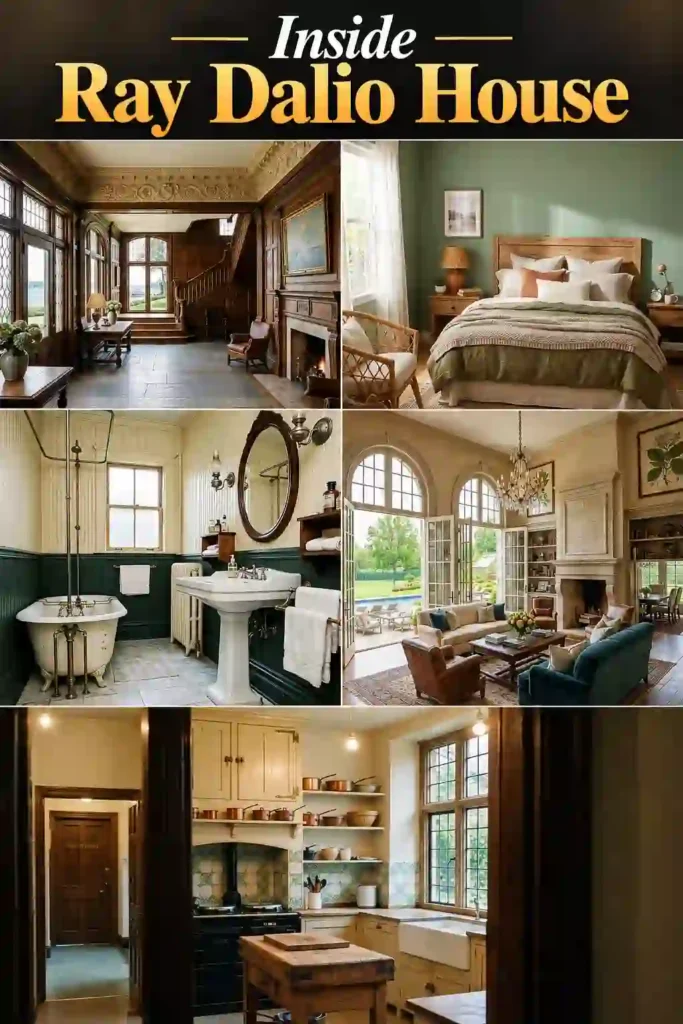
Grand Entrance
Copper Beech Farm’s entrance sequence begins well before the front door. A winding driveway of approximately 1,800 feet approaches the main residence through the landscaped grounds. Tree-lined sections create a formal approach suited to the scale of the estate.
The mansion’s French Renaissance character provides the architectural focus at the end of that approach. Its historic design and substantial proportions distinguish the residence from more recent glass-and-steel luxury homes.
Available descriptions establish the driveway and exterior character, but they do not provide a complete verified inventory of the foyer’s furnishings, staircase, or decorative finishes. Detailed claims about those features would therefore be speculative.
Bedrooms
The main residence contains eight bedrooms, according to the property’s published listing. That count places the house within the category of large historic estates designed to accommodate family members, guests, and household needs.
The estate’s additional buildings expanded its overall accommodation options. Contemporary reporting described a three-bedroom gatehouse and a two-bedroom carriage house, separate from the main mansion. These structures helped distribute residential functions across the grounds.
Publicly available descriptions do not reliably document the layout, décor, or current use of each bedroom. Claims about individual bedroom suites, balconies, walk-in wardrobes, or personalized furnishings should not be treated as established facts.
Bathrooms
Eight full bathrooms and two half bathrooms appear in the historical listing for the principal residence. These figures refer to the main house rather than necessarily covering every bathroom across the estate’s separate buildings.
The published records do not provide a dependable room-by-room bathroom inventory. Specific claims about marble finishes, spa-style showers, freestanding tubs, or gold fixtures cannot be confirmed from the available property descriptions.
Living Areas
The mansion’s 13,519 square feet of interior space accommodates its formal and residential functions. Oak paneling, plaster friezes, multiple fireplaces, and high ceilings are among the documented architectural details.
Fireplaces and decorative plasterwork contribute to the historic character of the principal rooms. Oak paneling provides another period detail, distinguishing the mansion’s interiors from the neutral finishes often associated with newly built luxury properties.
No reliable public inventory establishes the exact number or present arrangement of drawing rooms, libraries, family rooms, or entertainment areas. Those layouts should not be inferred from the property’s overall size.
Kitchen
A large historic residence of this scale requires substantial food-preparation and dining facilities, but the available property descriptions do not provide a verified kitchen specification.
Published material does not reliably establish the kitchen’s dimensions, appliance brands, countertop materials, pantry arrangement, or renovation date. Consequently, descriptions of commercial-grade appliances, oversized islands, custom cabinetry, or chef-designed kitchens would go beyond the documented evidence.
The estate’s size and separate support buildings indicate a complex residential property, but they do not prove any particular kitchen layout.
Unique and Special Spaces
Copper Beech Farm’s most distinctive spaces extend beyond the principal residence. The estate contains a carriage house, a gatehouse, a pool house, and two greenhouses. Each is a separate structure with a different role within the broader property.
The carriage house and gatehouse add historic character while expanding the estate’s building inventory. The pool house supports the outdoor swimming area, and the greenhouses add a horticultural element to the landscaped grounds.
An apple orchard provides another unusual feature for a major waterfront property near New York City. Formal walled gardens, open lawns, and private beaches create several distinct outdoor environments across the estate.
These documented features help explain why Copper Beech Farm attracted attention beyond its headline sale price. Its value lay partly in the combination of historic architecture, extensive land, and facilities spread throughout the grounds.
Security and Privacy
Copper Beech Farm’s private peninsula, extensive grounds, and long driveway create physical separation between the principal residence and surrounding public areas. Its substantial acreage also allows the main house to sit well away from the entrance.
Those characteristics provide general privacy benefits without establishing the details of any security system. Reliable public descriptions do not verify specific camera networks, alarm installations, guard arrangements, or access-control technology.
No such details are necessary to understand the estate’s residential layout. The documented land area, driveway, and coastal setting already explain how the property’s design separates its living spaces from the surrounding community.
Ray Dalio House Sale History and $138.83 Million Deal
Copper Beech Farm’s 2023 sale is the strongest documented fact behind its association with Dalio. The estate sold for $138,830,000 in August 2023, setting a Connecticut residential real-estate record at the time.
The property entered the market in February 2023 with an asking price of $150 million. Its final sale price was therefore approximately $11.17 million below the asking figure. That difference represents a negotiated transaction price, not a later estimate of the estate’s current value.
An earlier transaction in 2014 had brought approximately $120 million. The 2023 sale thus exceeded that reported price by about $18.83 million, although the figures do not account for holding costs, taxes, capital improvements, or other expenses.
The buyer’s identity was not disclosed by Sotheby’s International Realty. Property records identified LCT Range, LLC as the buyer, while The Conservation Institute appeared as the previous owner. Greenwich Time reported the latter company’s connection to Bridgewater through a business email listed in a state filing.
The corporate connection is significant, but it does not establish direct personal ownership by Dalio. Reporting linked the seller to the hedge fund he founded; the transaction records cited in contemporary coverage did not name him as the individual buyer or seller.
The $138.83 million figure should therefore be understood as the verified sale price of Copper Beech Farm, not proof that Dalio personally sold a mansion titled in his own name.
What Is the Current Value of Ray Dalio House?
Copper Beech Farm’s last widely reported transaction provides the clearest benchmark for its market value. The estate sold for $138.83 million in 2023 after entering the market at $150 million. No verified current appraisal or subsequent arm’s-length sale price is established by the cited reporting.
A current valuation would require more than adjusting the 2023 price for general real-estate appreciation. Changes in coastal property demand, maintenance costs, the condition of historic buildings, and the value of the land could all affect a new assessment.
The reported sale figure should not automatically be presented as the property’s present-day worth. Nor should it be described as the current value of a house personally owned by Dalio, because his direct ownership of Copper Beech Farm has not been conclusively established in the cited records.
The estate remains a useful reference point for understanding record-setting residential property prices in Greenwich. Its historic mansion, acreage, shoreline, and outbuildings distinguish it from properties whose value depends primarily on interior square footage.
Other Properties Owned by Ray Dalio
Dalio’s long career in investment management has made him one of the world’s wealthiest investors, but public estimates of wealth do not establish the details of his real-estate portfolio.
Reliable reporting supports a connection between Dalio and Greenwich, Connecticut, as a place of residence. Forbes has listed Greenwich as his residence, but that broad designation does not identify a particular house or establish ownership of every estate associated with his name.
Claims about additional residences require separate evidence. A property appearing in online celebrity-home articles is not necessarily owned by Dalio, and an investment company connection does not automatically prove personal ownership.
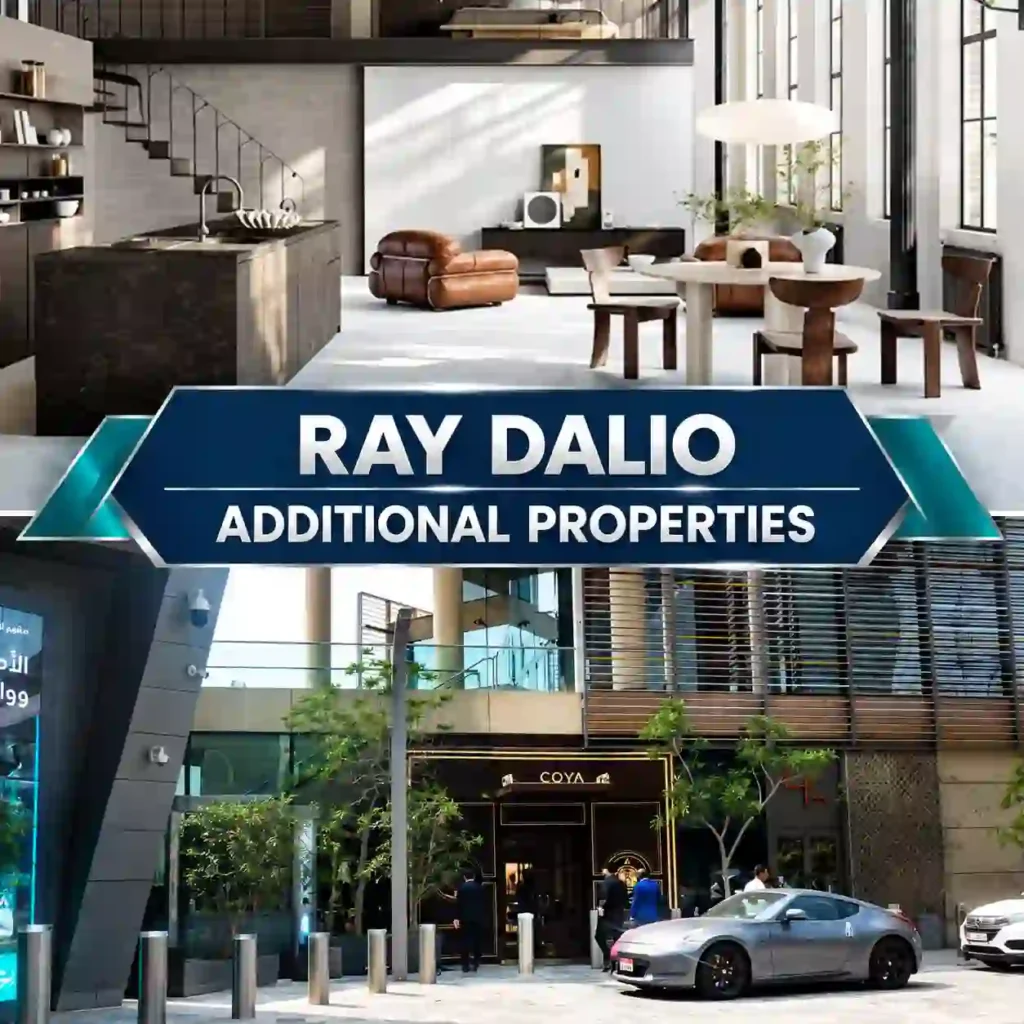
SoHo Loft in New York City
Claims that Dalio owns a specific loft in Manhattan’s SoHo neighborhood require reliable ownership records or credible reporting identifying the property. The available evidence cited for this article does not establish a particular SoHo address, purchase price, floor area, or ownership period linked directly to him.
Dalio’s professional history includes an important New York connection. Forbes reports that he launched Bridgewater Associates from a two-bedroom New York City apartment in 1975. That historical detail concerns the firm’s beginnings, however, and does not establish that he currently owns a SoHo loft.
The distinction matters because an apartment used during an earlier stage of a career may be rented, sold, or unrelated to a later property claim. Without additional documentation, a specific SoHo residence should not be presented as a confirmed part of his portfolio.
Reported Property in Abu Dhabi
Claims of a Dalio-owned property in Abu Dhabi also require independent verification. The available evidence does not establish a named residence, a documented purchase, a property address, or an ownership entity that can confidently be attributed to him.
Business travel, investment relationships, and visits to the United Arab Emirates would not, by themselves, demonstrate residential ownership. Likewise, a report that lacks property records or credible corroboration cannot establish that a mansion or apartment belongs to the billionaire.
Consequently, an Abu Dhabi residence cannot be treated as a confirmed holding in his real-estate portfolio on the evidence available here.
Does Ray Dalio Own Property in Spain?
No sufficiently reliable evidence cited here establishes that Dalio personally owns a house, villa, or estate in Spain. Claims about a Spanish residence should remain unconfirmed unless supported by credible reporting, property documentation, or a direct statement.
International property ownership can be difficult to establish when a company or intermediary holds legal title. Even so, that possibility does not justify assigning an unverified property to a named individual.
The same standard applies to the Ray Dalio house claims circulating online: a location, photograph, or association with a wealthy investor is not proof of ownership. Spain should therefore not be included among his confirmed residential holdings without stronger documentation.
Where Does Ray Dalio Live Today?
Forbes lists Greenwich, Connecticut, as Dalio’s residence in its published billionaire profile. That information supports Greenwich as his reported residential base, but it does not establish the exact house he occupies today.
His connection to Connecticut is closely associated with Bridgewater Associates, the investment firm he founded in 1975. The company grew into a major hedge fund business, establishing a long-term professional connection between Dalio and the state.
Copper Beech Farm should not automatically be identified as his current residence. The estate sold in August 2023, and its buyer was recorded as LCT Range, LLC. Available reporting does not establish that Dalio personally acquired the property or continued living there after the transaction.
The safest conclusion is that Greenwich remains his reported residential location, while the identity and ownership history of his specific current home require further verification.
Ray Dalio Net Worth: How Wealthy Is He?
Forbes estimated Dalio’s real-time net worth at approximately $18.9 billion as of September 10, 2026. Its published profile also recorded a net worth of $15.4 billion for the 2025 Forbes 400 list. These figures are estimates of his overall wealth, not measurements of his residential property holdings.
His fortune developed primarily through his work in investment management and the growth of Bridgewater Associates. Forbes reported that he stepped down as the firm’s chief executive in 2017, retired as co-chief investment officer in 2022, and sold his remaining stake by 2025.
Dalio’s wealth provides context for his association with expensive real estate, but it does not verify individual property claims. A billionaire’s estimated net worth can include investments, cash, business interests, and other assets that have no direct connection to residential property.
Copper Beech Farm’s $138.83 million sale illustrates the scale of the luxury property market associated with his business network. However, the transaction price cannot be used to calculate his personal property wealth without confirmed ownership and financial records.
Frequently Asked Questions About Ray Dalio House
Q: Did Ray Dalio Actually Own Copper Beech Farm?
Public reporting linked Copper Beech Farm to Dalio through The Conservation Institute, an LLC identified as the previous owner. A state filing reportedly associated the company with a Bridgewater email address. However, those corporate links do not conclusively establish that Dalio personally owned the estate. The property sold for $138.83 million in August 2023, and the recorded buyer was LCT Range, LLC.
Q: Does Ray Dalio Still Own a House in Greenwich, CT?
Forbes identifies Greenwich, Connecticut, as Dalio’s residence, but that designation does not establish the ownership status of a particular house. Copper Beech Farm sold in 2023, and available records do not conclusively identify it as a property he personally owned. His current homeownership details cannot be confirmed from the cited evidence.
Q: Is Ray Dalio’s House in Spain Real?
No reliable evidence cited here confirms that Dalio owns a house in Spain. Without credible property records, a direct statement, or corroborated reporting, the claim remains unverified. A Spanish villa should not be described as his property merely because online articles associate it with his name.
Conclusion
Copper Beech Farm remains notable for its 1898 French Renaissance mansion, approximately 50 acres of waterfront land, historic grounds, and record-setting 2023 sale. The estate’s $138.83 million transaction is documented, but its association with Ray Dalio requires an important qualification: corporate links to Bridgewater Associates do not prove personal ownership. Forbes identifies Greenwich as his residence, yet the precise home he currently owns or occupies remains unclear. Understanding the distinction between a confirmed property sale, a reported residential location, and an unverified ownership claim provides the clearest account of the Ray Dalio house story.